Every modern call center is under pressure to do more with less. Customers expect fast answers, personalized support, and consistent service quality whether they reach out by phone, chat, or SMS.
Meanwhile, contact centers and everyday businesses alike are juggling more complex interactions and growing pressure to improve customer satisfaction without overwhelming support teams.
That is exactly why more businesses are investing in call center quality assurance software.
Modern call center quality assurance software helps businesses move beyond manual reviews and limited call monitoring.
Instead of reviewing only a small percentage of customer interactions, AI-powered quality assurance software gives QA teams visibility into conversations across the entire customer journey.
These platforms combine automated QA, speech analytics, sentiment analysis, machine learning, and natural language processing to improve call center quality while reducing manual workloads.
Many modern communication platforms are also beginning to incorporate conversational AI tools that can answer customer questions, book appointments, summarize calls, qualify leads, and intelligently transfer callers when live support is needed.
What Is Call Center Quality Assurance?
Call center quality assurance is the process of evaluating customer interactions to improve service quality, maintain compliance, and optimize agent performance. A strong QA program helps call center teams regularly monitor calls, review customer feedback, and identify trends that impact customer outcomes.
For years, traditional quality assurance relied heavily on manual QA reviews where QA analysts listened to a small sample of calls and scored them one by one. Modern call center quality assurance software changes that approach by allowing contact centers to analyze 100% of interactions instead of just 1-3%.
Today’s call center QA software actively scores interactions against criteria like empathy, resolution quality, script adherence, and compliance. This gives QA teams better insights and more consistent quality across every communication channel.
Why Manual QA No Longer Works at Scale
As contact centers and businesses grow, the traditional QA process quickly becomes difficult to manage. Managers can spend hours reviewing recordings, evaluating agent performance, and documenting coaching recommendations instead of actually coaching their teams.
Manual QA also creates major visibility gaps. Reviewing a handful of calls rarely tells the full story of what customers are actually experiencing across a busy call center.
Modern call center quality assurance and contact center quality assurance platforms solve this problem through automated quality assurance and AI-driven quality monitoring. Instead of relying on random samples, QA software can analyze thousands of customer interactions every day.
This helps businesses and contact center operations:
- Improve agent performance
- Maintain consistent service quality
- Reduce compliance risks
- Monitor agent performance more accurately
- Improve customer satisfaction
- Scale quality assurance efficiently
How AI Improves Call Center Quality
AI-powered call center quality assurance software helps businesses improve operational efficiency without adding more manual work for supervisors.
Modern quality management software uses analytics tools like speech analytics and sentiment analysis to evaluate agent performance in real time or near real time. These systems can identify trends, flag compliance risks, and uncover coaching opportunities automatically.
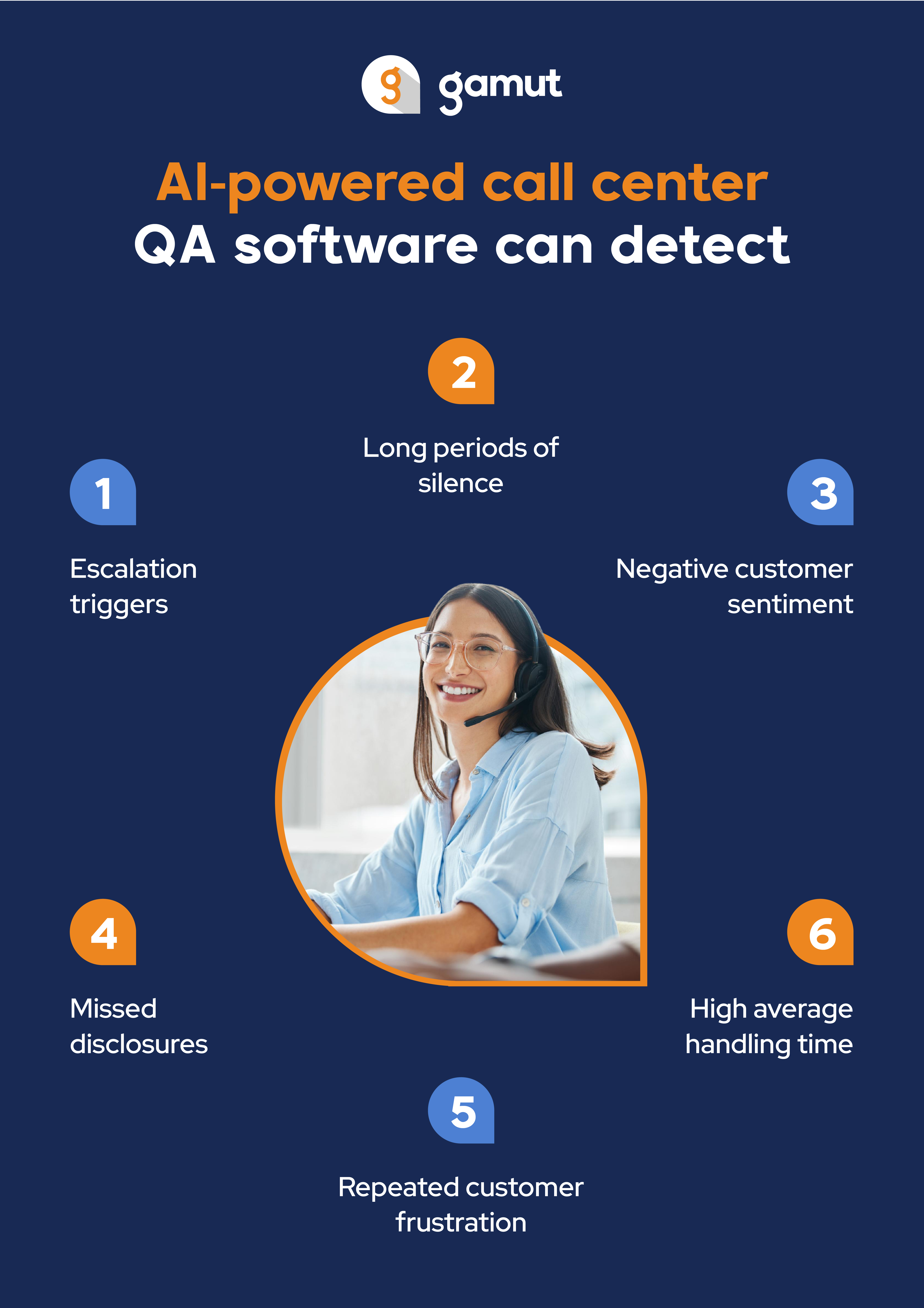
For example, AI-powered call center QA software can detect:
- Escalation triggers
- Long periods of silence
- Negative customer sentiment
- Missed disclosures
- Repeated customer frustration
- High average handling time
This creates actionable insights that help QA teams make faster process improvements.
AI Is Expanding Beyond QA Into Smarter Customer Conversations
Modern AI tools are no longer limited to reviewing calls after conversations happen. Businesses are increasingly using conversational AI to actively support customer interactions in real time.
Today’s AI-powered communication platforms can:
- Answer calls 24/7
- Handle common customer questions
- Book appointments and confirmations
- Qualify leads before handing them to staff
- Route callers intelligently to the right department
- Improve after-hours responsiveness
- Generate AI-powered call summaries for teams
Unlike traditional phone trees or rigid automated attendants, newer conversational AI systems are designed to sound more natural and create smoother customer experiences.
This shift is helping businesses improve responsiveness without increasing staffing demands. It also gives customer service teams better visibility into conversations through AI-generated summaries, interaction tracking, and automated conversation analysis.
For industries like healthcare, insurance, home services, legal offices, dealerships, and real estate, these tools are becoming especially valuable for handling high volumes of routine inquiries while ensuring customers still reach live staff when necessary.
AI Coaching Helps Improve Agent Performance
One of the biggest advantages of call center QA software is that it helps managers improve agent performance without turning coaching into a full-time administrative task.
Traditional quality assurance software often slowed coaching down because supervisors first had to review calls manually. Modern QA platforms automate much of that work, so feedback can happen much faster.
Today’s call center QA software can support advanced coaching workflows with real-time agent guidance, performance dashboards, and automated scoring.
Data-driven coaching allows managers to personalize agent training based on QA data and key performance indicators. Instead of generic feedback, agents receive actionable feedback tied directly to customer interactions and performance monitoring.
This helps optimize agent performance while supporting continuous improvement across the call center.
Some platforms are also beginning to combine AI coaching with AI-powered interaction support, allowing businesses to improve both employee performance and customer engagement workflows within the same communication environment.
Sentiment Analysis Improves Customer Experience Visibility
Call center sentiment analysis helps businesses understand how customers actually feel during conversations, not just whether the issue was technically resolved.
Using natural language processing and machine learning, modern quality management software can evaluate tone, pacing, emotion, and conversational patterns.
This gives contact center quality assurance teams better visibility into customer experience trends that might otherwise go unnoticed.
For example, sentiment analysis may reveal:
- Billing frustrations
- Product confusion
- Escalation risks
- Poor handoff experiences
- Training gaps affecting service quality
These QA insights help contact centers enhance customer experience and improve customer retention over time.
Better QA Tools Support Better Compliance
Compliance remains a major concern for contact centers, especially as communication volumes continue to grow.
Modern call center quality assurance software can automatically detect missed disclosures, risky language, and policy violations during live or post-call reviews. Many QA tools also integrate directly with workforce management tools, CRM platforms, and workforce management platforms to centralize quality management workflows.
This reduces compliance risks while helping businesses maintain high-quality service across every call center interaction.
Many call center quality assurance software platforms also support human and AI evaluations together, giving organizations flexibility in how they structure their QA workflows and quality management strategies.
What Features Should Businesses Look For?
The best call center quality assurance software should support both quality monitoring and long-term quality management.
Businesses evaluating call center QA software should look for:
- Automated quality monitoring
- AI conversation summaries
- Performance monitoring dashboards
- Coaching tools
- Real-time alerts
- Contact center quality assurance reporting
- QA workflows and calibration support
- Integration with CRM and call center systems
- Scalable call center QA capabilities
- Conversational AI capabilities
- AI-powered appointment scheduling
- Intelligent call routing and transfer workflows
- Multichannel customer engagement support
Strong call center quality assurance and contact center quality assurance platforms help businesses maintain consistency while giving managers better visibility into agent performance and customer outcomes.
Better Conversations Start With Better Visibility

Quality assurance is no longer just about checking boxes or scoring calls. Modern call center quality assurance software has become an important business tool for improving customer experience, service quality, and operational performance across the entire call center.
AI-powered call center quality assurance software like Gamut's helps contact centers move beyond reactive reviews and manual QA processes by delivering deeper visibility into customer interactions, various call center metrics, and agent performance.
With automated QA, performance monitoring, call center sentiment analysis, conversational AI tools, and smarter quality management software, businesses can strengthen their QA program, support QA teams more effectively, and create better customer outcomes across the entire call center environment.
As AI-powered communication platforms continue to evolve, businesses will gain even more opportunities to improve responsiveness, streamline customer interactions, and create better experiences across every conversation.
If you're ready to meet customer expectations better with modern AI call center quality assurance software, reach out. Gamut is always happy to help!
%20(1).jpg)

.jpg)