.jpg)
A school intercom is more than just a way to make announcements. They help connect classrooms, offices, administrators, facilities teams, and other staff across a campus while supporting both everyday communication and school emergency communication.
When it works alongside the broader school communication system, the classroom intercom becomes part of an even more connected environment where messages can reach the right people quickly without requiring staff to jump between separate systems.
What Does a Modern School Intercom Do?
A modern school intercom helps schools share information across classrooms, hallways, offices, common areas, and outdoor spaces.
That can include:
- Daily announcements from the main office
- Updates to bell schedules
- Targeted messages to specific classrooms
- Zone-based paging for certain wings or buildings
- Two-way communication between the office and a classroom
- Messages to parking lots or outdoor areas
- Support for emergency announcements and other urgent communication
For most schools, that means the intercom isn’t just a PA system. It’s part of a bigger communications system that helps people communicate throughout the school day.
Modern intercom systems also connect with intercom stations, a paging system, LED message boards, classroom speakers, and other technologies already in use.
How Can a School Intercom Improve Daily Operations?
The easiest way to understand the role of an intercom is to follow one message through a school.
Imagine a water issue closes a hallway for part of the morning.
The main office needs to notify nearby teachers. Facilities staff need to coordinate access. Administrators will need to update office staff. Students need clear directions without interrupting the entire school day.
With a connected school intercom system, staff can initiate a targeted message to the affected area. Zone-based paging can limit the announcement to the right part of the building and specific classrooms can use two-way communication if they need clarification.
If the issue affects another location, the district can make a public address to extend that same communication across multiple buildings.
That’s what efficient communication looks like in practice. The people who need the information get it, while everyone else can continue with their normal routines.
It also improves overall efficiency by reducing unnecessary calls, repeated announcements, and manual handoffs between departments.
How Does an Intercom Fit Into a Connected School?
A school intercom works best when it isn’t treated as a standalone system.
Schools already have phone systems, messaging tools, emergency platforms, access systems, paging equipment, and other communication technology. When those pieces operate independently, staff have to repeat the same message in several places.
A connected approach can integrate intercoms with the broader school environment.
Depending on the school’s needs, that could mean connecting the intercom with:
- The school’s phone system
- Mass notification systems
- Access control
- Critical emergency notifications
- Message boards
- Other campus communication tools
Most educational institutions already have useful existing infrastructure that can continue to play an important role, so it's not about replacing everything.
Instead, school leaders can look at where better integration would make communication easier.
How Do Intercom Systems Support School Safety?
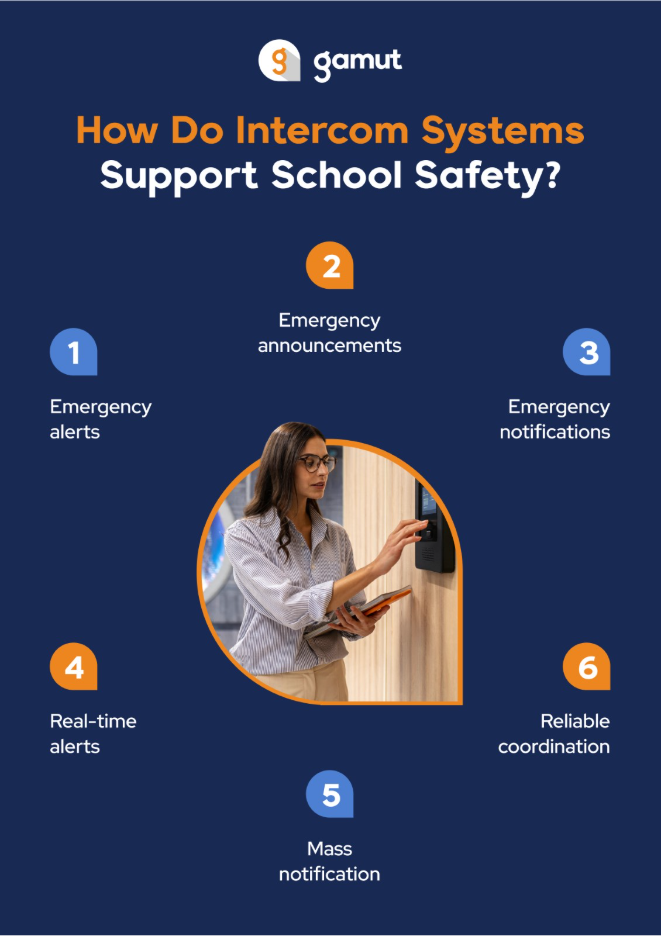
Intercoms also play an important role in safety and security, but they’re only one part of a broader plan.
During severe weather, a facility issue, or other emergency situations, schools might need to send urgent messages to classrooms, offices, outdoor spaces, or the entire campus.
A modern intercom can support:
- Emergency alerts
- Emergency announcements
- Emergency notifications
- Real-time alerts
- Mass notification
- Reliable coordination with mass notification systems
Some campuses might also use emergency towers, access control, or communication channels involving local authorities.
The ability to integrate these technologies can support a more coordinated emergency response.
Still, the technology itself isn’t the full answer.
Schools also need clear safety protocols, regular training, and established procedures for how staff should respond during emergencies. If a district introduces new safety protocols, those processes should guide how the intercom and other systems are used.
Some districts also evaluate PASS guidance or work with a PASS partner as part of their bigger school safety planning.
When Should a School Review Its Current Intercom System?
An older intercom doesn’t automatically need to be replaced.
The better question is whether the current system still supports how the school operates today.
School leaders should ask:
- Can the office reach one classroom without paging the whole building?
- Can staff communicate across multiple buildings?
- Can messages reach outdoor areas and parking lots?
- Can the system support reliable two-way communication?
- Can it work alongside newer technologies?
- Can the district connect paging with critical emergency notifications or mass notification systems?
- Can staff use the system reliably without complicated workarounds?
- Does it support the needs of the entire district, not just one building?
A school district with multiple campuses needs different capabilities than a single building. High schools also have different requirements than elementary schools because of their size, layout, and number of activity spaces.
The right solution depends on how the school actually operates.
What Should Schools Consider Before Modernizing an Intercom?
Before choosing new solutions, start with communication workflows instead of product features.
Ask how information moves through the school today.
Who needs control over announcements? Who should be able to send messages? Which spaces are difficult to reach? How does the system work with the school’s network? What happens if staff need help from another building?
It’s also worth reviewing:
- Existing infrastructure
- Future expansion needs
- Support requirements
- PA system reliability
- Staff training
- Integration with other communication and security systems
- The ability to test emergency workflows regularly
For K-12 communications, the best approach often combines what’s already working with targeted improvements.
That can mean adding new intercom stations, improving paging, connecting multiple locations, or creating better integration between the intercom and the larger school communication system.
Why Does the School Intercom Still Matter?

Phones, apps, messaging platforms, and other digital tools have changed how schools communicate, but the intercom still serves a very practical purpose.
It can reach people where they are without requiring everyone to check a device. It can support one classroom, one building, or the entire school community. It can also help connect daily operations, facilities, administration, and safety.
That’s why intercom systems for schools still matter.
The best school intercom isn’t necessarily the newest or most complicated system. It’s the one that fits the way your school or district communicates and works with the broader infrastructure already in place.
For Massachusetts schools reviewing K-12 communications, Gamut can help evaluate current systems, identify communication gaps, and determine where modernization or integration can make sense.
Gamut will be at the MassCUE Fall Conference on October 14 and 15, giving Massachusetts education leaders an opportunity to talk through school paging systems, classroom intercoms, school emergency communication, and bigger campus communication needs.
Eligible organizations can also explore MHEC pricing and procurement options when evaluating new solutions. Contact us for more info!
Frequently Asked Questions About School Intercom Systems
What is a school intercom system?
A school intercom system helps staff send announcements, paging messages, and other communication throughout a school or campus. Modern systems also support targeted paging, classroom communication, and integration with other school technologies.
What’s the difference between a school intercom and a school paging system?
A school paging system generally focuses on broadcasting messages, while a modern intercom can also support two-way communication, targeted messages, and connections with other campus systems.
Can school intercom systems connect with emergency systems?
Yes. Depending on the technology and existing infrastructure, schools might be able to integrate intercoms with mass notification systems, access control, emergency platforms, and other communication technologies.
Do schools need to replace their entire intercom system to modernize?
Not always. In most cases, schools can evaluate what’s already working and determine where upgrades, integration, or additional equipment would create more effective communication.
What should schools look for in intercom systems for schools?
Key considerations include reliability, targeted paging, integration options, support for multiple buildings, staff usability, safety and security requirements, and how well the system fits the school’s everyday communication needs.
.jpg)
%20(1).jpg)