%20(1).jpg)
If you've been researching a new business phone system, you've probably seen the term SIP trunking. It usually shows up next to VoIP, cloud communications, and other telecom language that can make a straightforward topic feel unnecessarily complicated.
So, what is SIP trunking?
In simple terms, SIP trunking refers to a way of making and receiving phone calls through an internet connection instead of relying on traditional phone lines.
A SIP trunk creates a virtual connection between your phone system and the public switched telephone network, allowing your business to communicate without a separate physical phone line for every call. SIP channels correspond to one simultaneous inbound or outbound call.
A SIP trunking system can be a practical way to modernize your communications while continuing to use compatible existing equipment.
What Is SIP Trunking? Breaking It Down Further
Let’s start with the name. What does SIP stand for?
SIP means session initiation protocol. It's a signaling protocol used to begin, manage, and end communication sessions.
Sessions like voice calls, video, instant messaging, and other messaging services.
A trunk is a shared pathway that carries multiple calls between a private branch exchange (PBX) and the telephone network. Older systems used analog phone lines or a primary rate interface (PRI) to create that physical connection.
With SIP, the connection becomes digital. A SIP trunk acts as a bridge between an existing PBX or IP PBX and the public switched telephone network (the traditional telephone system).
Put simply, SIP helps set up and manage the call while your IP network carries the voice traffic.
How Does SIP Trunking Work?
How does SIP trunking work behind the scenes?
When someone places a call, the phone or application sends a request to the business phone system. The system passes that request through the SIP service to the provider.
From there, the SIP trunking provider routes the call to the public switched telephone network (PSTN).
The PSTN connects landlines, mobile phones, and business systems worldwide.
For outbound calls, the call travels from your office through the SIP trunk provider to the recipient. Incoming calls follow the same path, just in reverse.
A SIP trunking service might support inbound and outbound calls, local numbers, toll-free numbers, international calls, number porting, call origination, and other advanced features.
Exactly what's included depends on the provider and service plan you choose.
Is SIP Trunking the Same as VoIP?
SIP trunking and VoIP technology are related, but they are not the same thing.
VoIP, or Voice over Internet Protocol, is the broad technology used to place VoIP calls over the internet. SIP trunking is one method businesses use to connect those calls to the outside telephone network.
A hosted VoIP solution puts most of the communications system in the cloud, with employees connecting through phones, applications, browsers, or computers.
SIP trunking typically lets a company keep its current phone system on-site. The SIP trunk links that equipment to a SIP provider or internet telephony service provider.
This can make SIP trunking appealing to businesses that still have a dependable phone system but want to move away from older phone services.
How Is SIP Trunking Different From Traditional Phone Service?
Traditional service depends on physical phone lines installed at a specific physical location.
With many analog phone lines, each phone line supports one call at a time. A PRI can handle multiple channels, but businesses often have to purchase capacity in fixed blocks. PRI uses physical lines to transmit voice, unlike SIP.
SIP channels provide more flexibility. Each channel generally supports one of your concurrent calls, and businesses can add or remove capacity without installing another physical connection.
A SIP trunking system can also centralize phone numbers, routing, and call management across multiple locations.
Instead of managing separate services at every office, a business can create a more coordinated approach to communications across locations.
What Are the Benefits of SIP Trunking?
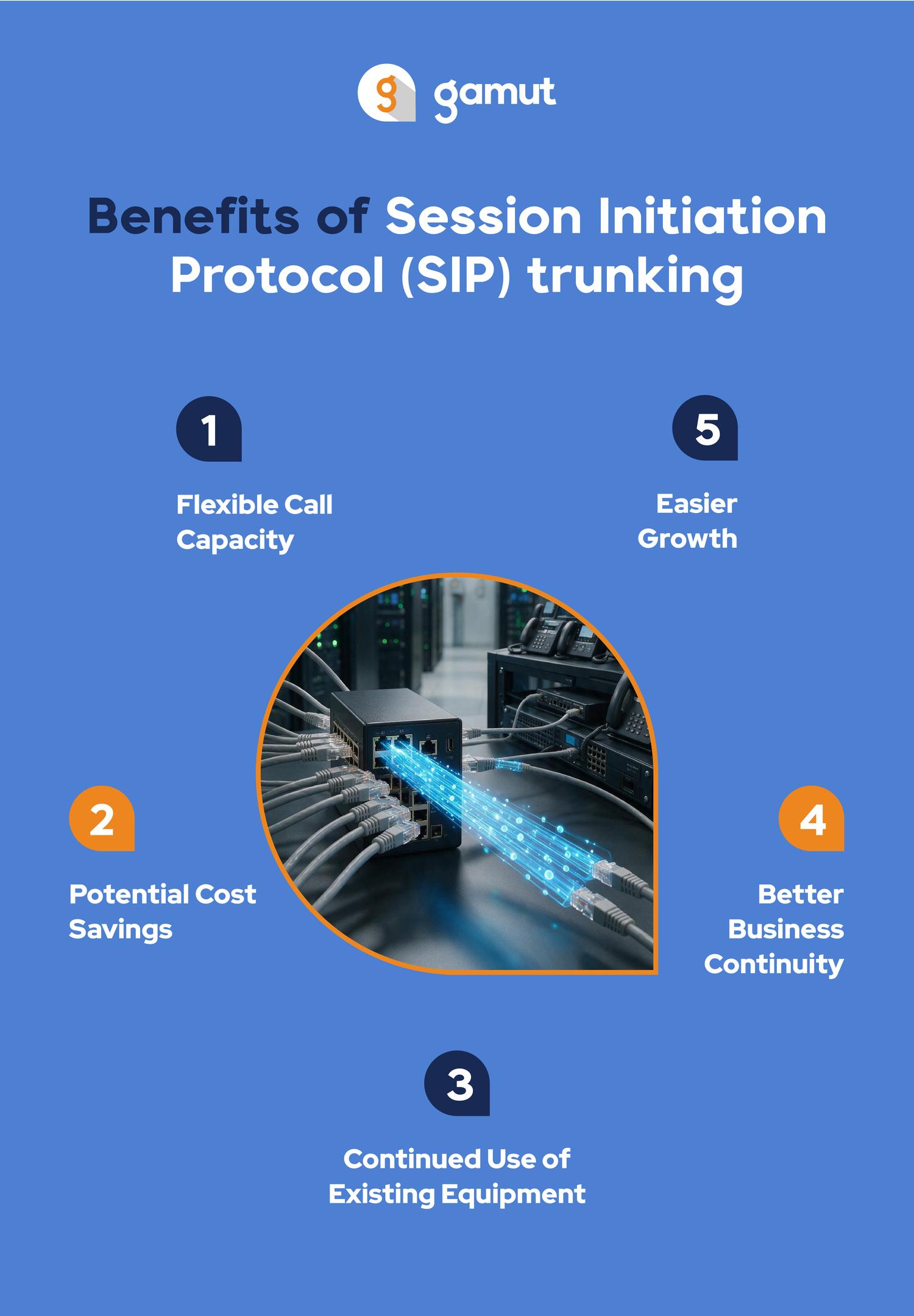
The key benefits of SIP trunking vary by company, but there are several worth considering.
Flexible Call Capacity
A SIP trunk can support multiple calls at once. Businesses purchase enough SIP channels for their expected concurrent calls and can adjust capacity as their needs change.
This can help businesses ranging from small offices to busy contact centers manage spikes in inbound and outbound calls.
Some providers offer elastic SIP trunking, which automatically adjusts available capacity as demand changes. This can be useful for businesses with seasonal demand or unpredictable call volumes.
Potential Cost Savings
SIP trunking cost can be more flexible than traditional circuit pricing.
Businesses may be able to reduce costs associated with maintaining traditional phone lines, long-distance calling, or separate voice services across multiple locations.
Actual cost savings vary, of course.
A fair cost comparison should include installation, support, equipment, and recurring fees rather than focusing only on the advertised monthly price.
Some providers also offer flexible pricing based on channels, call volume, locations, or usage. Businesses should compare these options carefully to understand which structure best matches their needs.
Continued Use of Existing Equipment
If an existing PBX or IP PBX still meets your needs, SIP trunking can allow you to continue using it while replacing older phone service.
This can help a company modernize gradually instead of replacing its entire phone system at once.
But, keeping existing equipment only makes sense when that equipment stays reliable, supported, and capable of meeting the organization’s communication needs.
Better Business Continuity
Because providers can route calls through software, SIP trunking can support stronger business continuity and disaster recovery planning.
If an office experiences a power outage, internet disruption, or temporary closure, incoming calls may be redirected to another office, mobile device, answering service, or backup number.
This gives businesses more options than a traditional physical line tied to a single building.
Easier Growth
Adding phone numbers, users, and offices can be easier because the service doesn't depend on adding new physical phone lines every time the company expands.
Businesses can often increase the number of SIP channels or update routing rules without waiting for entirely new circuits to be installed.
What Internet Connection Does SIP Trunking Need?
A reliable internet connection is essential because voice traffic travels across your network.
Calls don't always need enormous amounts of bandwidth, but they do need consistency. Packet loss, congestion, latency, or unstable service can affect call and voice quality.
Your IT team or communications advisor should review bandwidth, equipment, security, traffic prioritization, and backup connectivity.
Voice traffic may need to be prioritized so other online activity doesn't interfere with phone calls.
Businesses that depend heavily on calling may also need a secondary internet connection or backup routing plan.
What Equipment Is Required?
Equipment requirements depend on your current phone system.
An IP PBX might connect directly to a SIP trunking service. An older PBX might need a gateway or session border controller to communicate with the SIP server.
A qualified provider should review system compatibility, network readiness, security, and capacity.
The goal isn't to just make trunking work, it's to create a dependable setup that supports everyday operations and future growth.
When Is SIP Trunking a Good Fit?
SIP trunking can make sense when a business:
- Has a compatible existing PBX
- Wants to replace traditional phone lines
- Needs flexible capacity for multiple calls
- Operates across multiple locations
- Wants stronger business continuity
- Needs scalable SIP channels
- Isn't ready for a fully hosted platform
It can also be useful for a contact center that needs reliable call origination, toll-free numbers, outbound calls, or international calls.
When Might SIP Trunking Not Be the Best Choice?
SIP trunking may not be ideal if the current phone system is outdated, unreliable, unsupported, or costly to maintain.
Connecting modern service to failing equipment might only delay a larger upgrade.
A hosted VoIP platform might be better for businesses that want mobile tools, video, instant messaging, and advanced features without maintaining an on-site system.
Internet reliability is another important consideration. Before choosing a provider, confirm that the network can support consistent call quality and that there's a plan for outages.
How to Compare Leading SIP Providers
Leading SIP providers may seem similar, but service quality, support, security, and pricing can vary quite a bit. Look closely at each provider's network reliability, redundancy, service commitments, support, and approach to implementation rather than comparing on price alone.
Ask each SIP provider about:
- Network uptime and redundancy
- Number porting
- Emergency calling (E911 support)
- Support response times
- Disaster recovery options
- International calling rates and global coverage
- Available SIP channels
- Elastic SIP trunking
- Security and fraud prevention
- What happens during a power outage
You should also understand whether the company is the actual carrier, a reseller, or an internet telephony service provider that works with other networks.
Although SIP trunking can reduce communication costs by 40% to 90%, the lowest SIP trunking cost isn't always the best value. Reliability, knowledgeable support, and a clear implementation plan matter just as much.
What Is SIP Trunking? The Bottom Line.
So, what is SIP trunking exactly?
It is an internet-based service that connects a business phone system to the public switched telephone network. It replaces physical phone lines with a virtual connection, allowing businesses to make and receive calls through an IP network.
Monthly charges for SIP trunking are based on the number of channels, but setup fees for SIP trunking are often waived or bundled.
The main benefits of SIP trunking include flexibility, potential cost savings, improved business continuity, easier scalability, and the ability to keep compatible equipment.
However, the best choice still depends on your phone system, internet connection, call volume, internal resources, and long-term goals.
At Gamut, we help businesses understand their communication options before recommending a solution. Whether SIP trunking, hosted VoIP, or another approach makes the most sense, the goal stays the same: a reliable communications system that supports your business today and gives you room to grow.
.jpg)
.jpg)